
Conical Wedge Lock Washer Testing Our Junker test results and video evidence
We have performed extensive Junker Testing and here are some of our results. Haven’t got time to read? Then visit us or give us a call.
ON THIS PAGE
Introduction
Our Quality Management System is tightly integrated into our Product Design process and we are bound by our QMS that complies with 8.2 to 8.5 of the ISO9001:2015 standard.
The Junker test is the established method used for analysing the spontaneous self-loosening behaviour of secured threaded fasteners which make up a bolted connection under transverse loading conditions caused by vibrations. The engineer, Gerhard Junker, pioneered research into the behaviour of bolted connections under transverse loads, and his original methodology in this paper has been adopted into the international fastener standard, DIN 65151 - Dynamic testing of the locking characteristics of fasteners under transverse loading conditions. The DIN 25201-4 B, published in 2010, supersedes DIN 65151 and is significantly more rigorous.
The purpose of the tests is to determine and facilitate a comparative assessment of the self-loosening behaviour of bolted joints subject to dynamic transverse stress under defined test conditions. The comparative assessment is made possible by comparing the results of:
- reference tests using an unsecured bolted joint.
- verification tests using a bolted joint secured with the aid of a securing element
Reference Test
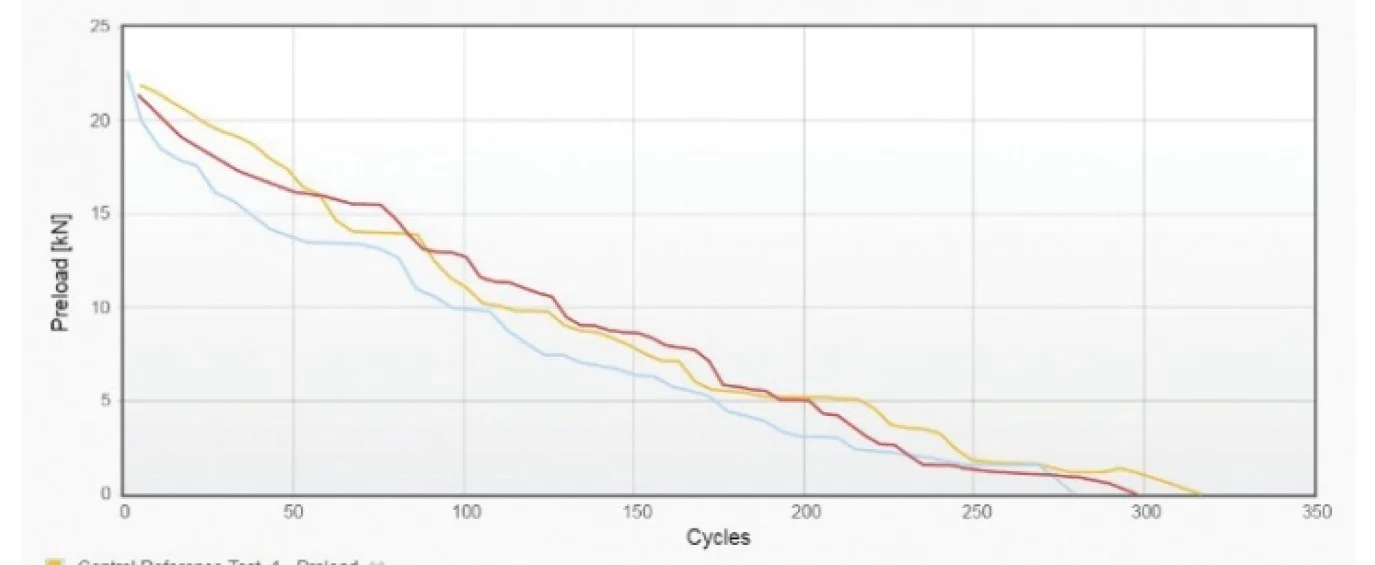
To start the reference test, the unsecured bolted joint (i.e., the fastener without any fastener locking element) must be placed in the test bench. Starting from zero, the displacement is gradually increased until the point at which the fastener completely self-loosens after 300 load cycles, ±100 load cycles. Once this efficient displacement has been discovered, three subsequent control tests with fresh components are required to ensure that the initial reference test results are consistent (see graph below).
Verification Test
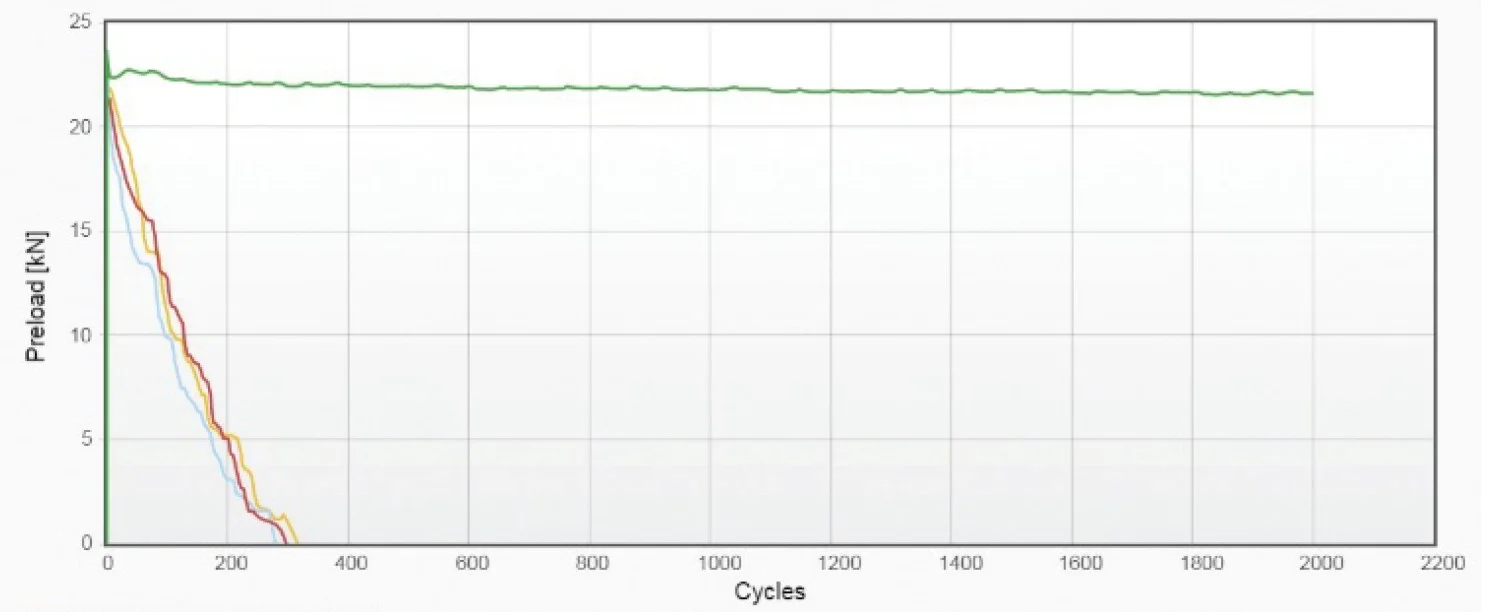
The next stage is to conduct the verification test. The exact same test conditions are set, including the same effective displacement. Then, the locking product is introduced, and the secured bolted joint is tested to determine whether and at what point the secured bolted joint starts to loosen. Several verification tests must be made in order to ensure the test reproducibility (See graph below)
Junker Test Bench
The testing of our Conical Wedge Lock Washers proved to be much more challenging than we had initially assumed it would be. We thought that either, our existing aerospace and mining clients or the independent industry testing laboratories, would have well established testing facilities and methodologies that we could leverage. For a variety of reasons, not least of which was the large bolt size which we needed to test (up to M110!), we had to develop our own testing facilities and methodologies ourselves. This took us well over a year to design, develop and implement. The testing of our M10 to M27 CWLWP (Conical Wedge Lock Washer Pairs), has been done on the apparatus shown below.
Testing Parameters
| Ref | Bolt Size | Class | Preload | Lubrication | k-factor | Torque | Clamp Length | Clamp Ratio | Disp | Freq |
|---|---|---|---|---|---|---|---|---|---|---|
| 1 | M10 | 8.8 | 27 kN | dry | 0.258 | 69 Nm | 40 mm | 4 | 3mm | 6Hz |
| 2 | M16 | 12.9 | 122 kN | greased | 0.206 | 401 Nm | 70 mm | 4.375 | 3mm | 5Hz |
| 3 | M24 | 10.9 | 234 kN | oiled | 0.153 | 1158 Nm | 100 mm | 4.7 | 4mm | 3Hz |
Video Evidence
Want to see it for yourself?
Visit us in Boksburg, or ask for test data on your bolt size and class.